
A 3-month somatic education program for when self-care isn’t the problem
Transform your relationship with care, safety and aliveness
EVEN IF YOU'VE READ ALL THE BOOKS, TRIED ALL THE STRATEGIES AND STILL CAN'T MAKE CARE STICK



CareWeaver is currently closed.
Join the waitlist and be the first to know when doors open so you don’t miss any of the early bird bonuses.


You know what you're supposed to be doing when it comes to ‘self care’…
You're smart. You've read the books. You've listened to the professionals.
You know exactly what you need to do for yourself – and you still can't seem to do it
You feel guilty when you rest, and exhausted when you push through
You've been in therapy, done courses, read the books – and something still feels missing
You scan outwards constantly – hyperaware of what everyone else needs, thinks and expects of you
Your body feels like a problem to be solved rather than a place you can actually live
You swing between overdrive and shutdown – and you're not sure there's anything in between
You've been told you're 'too much' or 'too sensitive' – and part of you believes it
If you're nodding along, you're in the right place. And nothing is wrong with you.

Not because you lack willpower. Not because you don't have enough energy. Not because your personality is flawed. And not because you're too complex with your overlapping diagnoses.
It's because the culture you grew up in taught you that care is something you earn. Something you justify. Something you get right – or fail at.
And when it doesn't stick, when that voice shows up and says you're not doing enough – you blame yourself.
You don't have a problem with self-care
You have a complicated relationship with care – because of the culture you live in.
What the books and experts often miss is this: there are real, tangible barriers between you and care.


There's a fine line between shame and care…
And most of us have been living on the shame side without realising
That's not a personal failure. That's what happens when a whole culture passes its complicated relationship with care down – and calls it self-improvement.
The patterns you've developed – the performing, the curating, the scanning for what's expected of you – these aren't dysfunctions. They're deeply protective human responses that once kept you safe.
But those patterns no longer protect. Now they cause pain, anxiety, stress, depression and chronic health symptoms.
And no amount of bubble baths, green smoothies or positive affirmations can touch what shame has wired into your nervous system.
You can't think your way out of this. You can only begin to feel your way through it – slowly, imperfectly, together.
Imagine what becomes possible when care stops feeling like another thing to get right
Imagine waking up and being able to sense what you actually need – not what you think you should need.
Imagine your body feeling like a place you can rest in, rather than a problem to manage.
Imagine being able to say no without the guilt spiral. Or saying yes without the resentment.
Imagine the freeze lifting. Not all at once – but enough that you can feel yourself again. Enough that movement doesn't feel impossible. Enough that the weight you've been carrying gets a little lighter.
Imagine care becoming something you can actually receive.
This is what CareWeaver participants describe – not in abstract terms, but in the texture of their actual lives:
"Life is ok at the moment and I'm really making great progress – not only mentally but physically too. I feel like by adding more movement to my day has helped so much. I'm really trying to embrace my quirks and be kinder to myself."
– CareWeaver participant
"I can be fully myself around you. There is no mask. It's like as soon as I go into that room with you, the mask comes off and I can let out a big sigh and feel relief as I'm in a safe place."
– CareWeaver participant
INTRODUCING
INTRODUCING
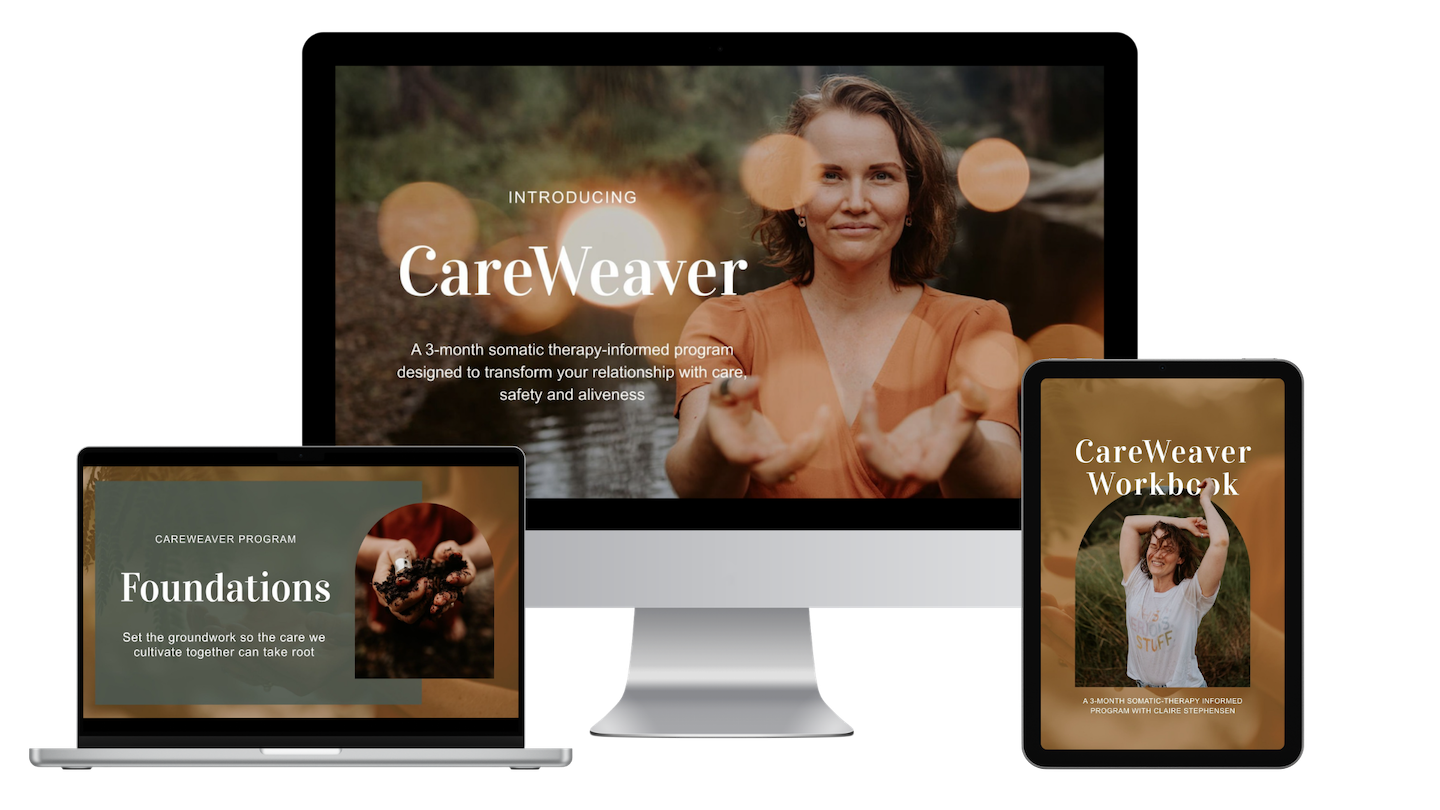
Six moves towards care when self-care feels impossible
CareWeaver
with Claire Stephensen
A 3-month somatic education program designed to transform your relationship with care, safety and aliveness.
This isn't another self-care course that gives you a list of things to do and hopes for the best.
CareWeaver takes you through the developmental movements of care – foundational experiences of being cared for that you may never have been shown, or had the chance to embody.
These are the movements that underpin your capacity for care – and without them, no strategy will ever stick.
CareWeaver isn't so much a program as it is a returning…
Yes, you'll learn the neuroscience behind why care feels so hard. Yes, you'll get practical tools you can use immediately.
But more than that – you'll learn to feel care in your body. To recognise what's been getting in the way. To move towards care with your whole self, not just your mind.
The end result: care stops being something you force and starts being something you live.
“I would highly recommend the Careweaver program to anyone that would like to deeply explore what care means to them, and to look at it under the lens of society's expectations of carers as well. If you want embodiment practices that you can support yourself with, and to be held in a safe and compassionate space, then this program is for you.”
– CareWeaver participant

CAREWEAVER IS THE FIRST PROGRAM OF ITS KIND THAT…
01
Starts with your body, not your behaviour
Most self-care programs hand you a list of habits and tell you to be more disciplined. CareWeaver starts where the real work lives: in your nervous system, your muscle memory, your protective patterns. We work with what your body already knows – not against it.
This isn't about personal failings. CareWeaver examines the shame-based cultural systems that shaped your relationship with care in the first place – so you can stop blaming yourself and start unhooking from expectations that were never yours to carry.
02
Names the cultural roots of why care feels so hard
Talking about care isn't the same as feeling it. Through movement, music, sensory practices and embodied exercises, CareWeaver helps you experience care as something your body can actually absorb – not just another concept your mind files away.
03
Uses somatic and creative practices – not just cognitive strategies
No pressure to overhaul everything at once. CareWeaver meets you exactly where you are and works with your capacity – through micro practices designed for the moments when everything feels too much, and macro practices for when you're ready to go deeper.
04
Builds care into your everyday life at a pace your nervous system can handle
this is for you if…
You're tired of living against yourself and you're ready to explore what living with yourself might feel like
You've tried the self-care strategies and they don't stick – and you suspect the problem isn't you
You live with chronic pain, complex trauma, neurodivergence or the effects of prolonged stress – and you want tools that work with your body, not against it
You're drawn to somatic, creative and embodied approaches rather than purely cognitive ones
You want practical tools you can use in your everyday life – not theory that sits on a shelf
You're looking for a space where the intense, the raw and everything in between has a home


this is not for you if…
You're looking for a quick fix or simple self care tips
You want someone to tell you what to do (CareWeaver supports you to find your own way)
You're in acute crisis and need immediate clinical support
You're not willing to be in a group setting where others may share vulnerable experiences
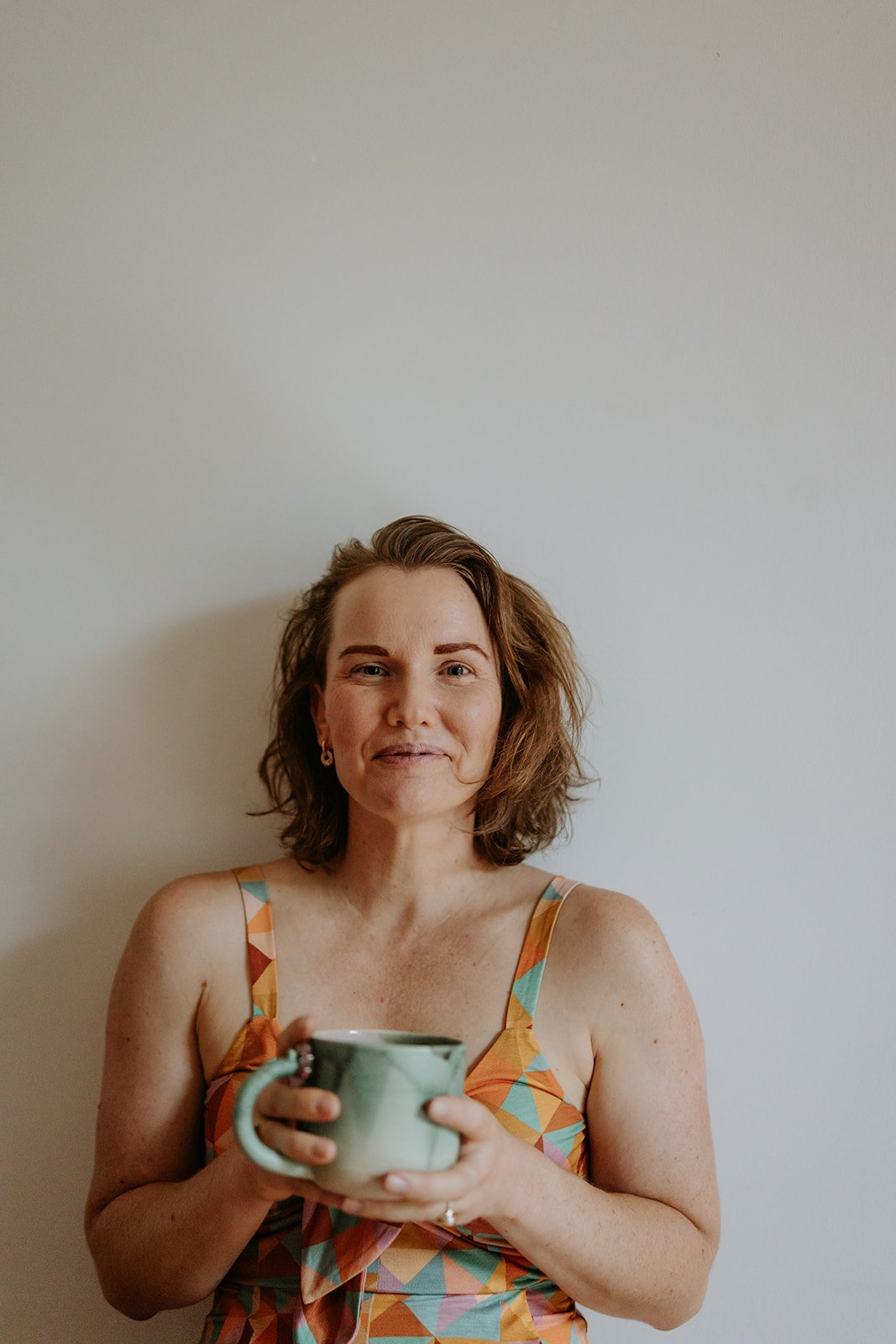

Hey there!
I’m Claire
"Claire has a gift to be able to hold space for others and bring forward what is in our hearts."
– CareWeaver participant
For the past 20 years, I've been exploring what it truly takes to move towards care – especially when it feels completely unfamiliar or out of reach. And for the last five years, I've been asking what it means to live and breathe care, even when there's nothing left to give.
I'm a somatic therapist, music therapist and neuropsychotherapist at Vera Wellness, a multidisciplinary medical and allied health clinic in the Samford Valley.
With over 15 years of clinical experience, my current work centres on chronic pain, complex trauma, attachment disruption and neurodivergence.
I started CareWeaver because I couldn't stay silent about what I was seeing: people blaming themselves for struggling with care, when the real issue was the shame-based culture they were swimming in. I wanted to create something that names that – and offers a way through that starts with the body, not the mind.
I'm one part wild creative, one part neuroscience nerd, one part nature-dweller and one part fierce activist. I believe that care isn't just personal – it's cultural. And that when we learn to weave care through our own lives, it ripples outward into our homes, relationships, workplaces and communities.
JOIN CAREWEAVER WITH CLAIRE STEPHENSEN
Everything you need to transform your relationship with care:
7 powerful modules across 3 months
7 live 90-minute calls on Zoom (with recordings available)
7 micro practices + 7 macro guided practices
Beautifully designed workbook
Curated playlists
Group message support between sessions
Lifetime access to all recordings and materials
Here's how it all unfolds
The CareWeaver Method moves through six core developmental movements of care, plus a foundations module to set you up, and an integration call to take it into your everyday life.
Each module builds on the last – and the fortnightly pace gives your nervous system time to integrate between calls.

Beginning
CaREWEAVER FOUNDATIONS
Set the groundwork so the care we cultivate together can take root.
We'll explore the core principles of CareWeaving, redefine what success means in this work, and create a dedicated space in your home to return to throughout our time together.

01
Module 01
ANCHOR
Create anchor points that can support you through inevitable challenge.
We'll find the somatic anchor points unique to you – points that help you stay steady while exploring new ways of being.
You'll practise pendulation, dual awareness and the art of expanding your capacity so you can rest more deeply into support.
02
Module 02
DISRUPT
Push back against expectations that were never yours to carry.
You've internalised messages that were never meant for you. Disrupt is your invitation to individuate – to remember that you are separate from others, from your past, and from the shame culture stories that shaped you.
You'll practise the art of pushing back and unhooking from pressures that no longer serve.
03
Module 03
LISTEN
Listen in a way that allows you to truly be heard.
Once you've felt where you begin and end, you can start to listen without bias.
This module invites you to tune in – not to narratives or diagnoses, but to your body's quiet language of sensation.
You'll explore the art of tracking and come into deeper relationship with your truth.

04
Module 04
MOVE
Care requires movement. Move closer towards it.
Care isn't passive. You'll bring your full body online and explore what it means to move towards care – even when shame or fear tells you not to.
Through posture shifts, proximity practices and nervous system-friendly challenges, you'll connect with the part of you that knows how to do hard things.

05
Module 05
RECEIVE
Care isn't just action – it's a resource you're allowed to receive.
It's one thing to move towards care. It's another to let yourself be nourished by it.
Here, we soften into receptivity, using the senses to explore what care feels like when it's truly absorbed.
You'll practise letting it in – through sound, scent, texture and presence.

06
Module 06
RIPPLE
Care isn't for hoarding – it's for sharing (without forgetting yourself).
When care is internalised, it naturally wants to flow outward.
This module explores how care can ripple through your movements, your home, your relationships and your community.
You'll practise letting care extend beyond your body – without abandoning yourself – through the 50/50 practice and intentional rituals of giving and receiving.
Closing
INTEGRATION
You've moved through the full arc of care – and this final module is where it becomes yours to keep.
Together we'll map out how and when to draw on each part of CareWeaver beyond the program, so the support doesn't end when the program does.
With group coaching woven through, this is where the learning stops being something you know and becomes something you actually live
“I just want to thank you so much for being so understanding, safe, accepting and so much more. It's allowed me to be more me in the group.”
– CareWeaver participant
“Claire holds such a nourishing, generous and responsive space that I couldn't help but feel held. My experience of Claire's facilitation was very generative.”
– CareWeaver Participant

Six moves towards care when self-care feels impossible
JOIN CAREWEAVER
We start on Tuesday 28th April 2026 with foundational content.
Live sessions will begin on Tuesday 5th May 2026 from 12-2pm AEST and will run fortnightly, with the final call closing on Tuesday 11th August 2026.
upfront
$1,200
One payment
payment plan
$300
TODAY
+3x ADDITIONAL payments of $300

Still have questions?
CHECK OUT THE FAQs
Here are some common questions people have asked before joining the CareWeaver Program. If your question isn’t answered here, please reach out to claire@careweaver.com.au and we’ll get back to you as soon as possible.
-
Great question. And the answer is: CareWeaver isn't a replacement for therapy. It's a completely different kind of container.
Therapy typically focuses on processing your personal history – often through talking. CareWeaver works at a different level. It addresses the cultural and developmental patterns that sit underneath your personal story – the ones that shaped your relationship with care before you even had words for it.
Many CareWeaver participants are also in therapy, and they find the two work beautifully together. As one participant's psychologist noted, the nervous system and safety work done in CareWeaver directly supports the trauma processing they do in session.
This is the work that fills the gap between knowing what you need and being able to do it.
-
Because most self-care programs start with behaviour change. They hand you habits and hope you stick with them.
CareWeaver starts with your nervous system. We address the shame and protective patterns that make care feel unsafe or impossible first – so that the practices you learn can actually land.
This isn't about adding more to your to-do list. It's about removing the barriers that have been keeping care out of reach.
-
Shame thrives in isolation. It tells you that you're the only one, that your experience is too much, that you need to sort yourself out before you can be around others.
A group is one of the most powerful antidotes to shame – because the moment you realise your experience is shared, something shifts in your nervous system that no amount of 1:1 work can replicate.
CareWeaver groups are small, carefully held and deeply respectful of each person's pace and boundaries. You won't be asked to share anything you're not ready to. And my facilitation creates a quality of safety that participants describe as unlike anything they've experienced.
-
CareWeaver opens Tuesday, 28th April 2026. Live sessions run fortnightly from Tuesday 5th May 2026; 12-2pm AEST. Full schedule provided upon enrolment.
-
Yes. All sessions are recorded and available within 24 hours. While attending live adds the richness of real-time connection, many participants get enormous value from the recordings, workbook, group message support and practices alone.
-
You can expect to put aside 10 minutes each day to get the most out of the content. Each day will look different depending on your capacity. Example days might look like:
Day 1: a 10 minute video/audio file for learning (or unlearning) core concepts
Day 2: 1 × 10 minute macro practice + micro practices woven throughout your day
Day 3: Mico practice woven throughout day
Day 4: Journal prompts + micro practices
Day 5: Macro practice
Day 6: Permission to not try :)
Day 7: Contribute to group chat
Beyond that, it's up to you – there's no no pressure, no 'right' way to do this.
-
CareWeaver is not therapy. It's a group education program informed by somatic psychotherapy, music therapy and neuroscience. If you're currently in therapy, CareWeaver can complement your work beautifully. If you're in acute crisis, please reach out to your therapist or GP first.
-
No. Many participants find that CareWeaver enhances their therapy work. The nervous system and safety foundations you build here can deepen what you do in your 1:1 sessions.
-
Absolutely. CareWeaver is designed with an awareness of how power, privilege and systemic oppression shape our relationship with care. Claire's work is informed by a commitment to decolonising healthcare and creating spaces where every part of you belongs. All identities, bodies and experiences are welcomed and honoured.
-
CareWeaver is for anyone who has a complicated relationship with care – particularly if you live with chronic pain, complex trauma, neurodivergence, burnout, or the effects of prolonged stress. You don't need a diagnosis. You don't need to have done therapy before. You just need to be willing to show up as you are.
-
CareWeaver is deeply relevant for health professionals, particularly those working in trauma-informed care, somatic practices, or allied health. While it doesn't currently carry formal CPD accreditation, participants are welcome to log it as self-directed professional development where their registration body allows.
-
If you feel your CareWeaver purchase hasn't delivered on a consumer guarantee under the Australian Consumer Law (ACL), please reach out to us at claire@careweaver.com.au to raise a claim.
We'll need your proof of purchase (order number or receipt) along with a short explanation of your concern.
Once we receive your claim, we'll work through it and offer an appropriate remedy in line with our ACL obligations. Please note that claims need to reach us within 7 business days of accessing the program – a window we consider reasonable given the nature of what's being offered.